
What is Bitcoin (BTC)

Updated: Sep 7
Bitcoin (BTC) is the world's first widely adopted decentralized cryptocurrency. It allows users to send and receive digital value through a peer-to-peer network without requiring a central bank to process each transaction.
But what exactly is Bitcoin, how does it work, and what can you use it for?
In this guide, we'll explain what Bitcoin is, how it was created, how the Bitcoin blockchain works, its main advantages and disadvantages, Bitcoin wallets, and practical ways BTC can be used.

₿ All About Bitcoin
Bitcoin can seem complicated at first, but its basic concepts are straightforward. To understand what is Bitcoin and how it works, we'll start with four key areas:
What Bitcoin Is → How Bitcoin Was Created → Who Controls Bitcoin → How Bitcoin Works
These fundamentals provide a clear foundation for understanding Bitcoin, its blockchain, and how BTC transactions work.

💡 Definition of Bitcoin
Bitcoin (BTC) is a decentralized digital asset and cryptocurrency that allows value to be transferred over a peer-to-peer network.
Unlike traditional currencies such as the US dollar (USD) or euro (EUR), Bitcoin is not issued by a central bank. Bitcoin transactions are recorded on a public distributed ledger known as the Bitcoin blockchain.
The network operates through participants around the world rather than being controlled by a single company, bank or government.
In simple terms:
Bitcoin → Digital Asset → Peer-to-Peer Network → Public Blockchain
🕰️ How Bitcoin Was Created
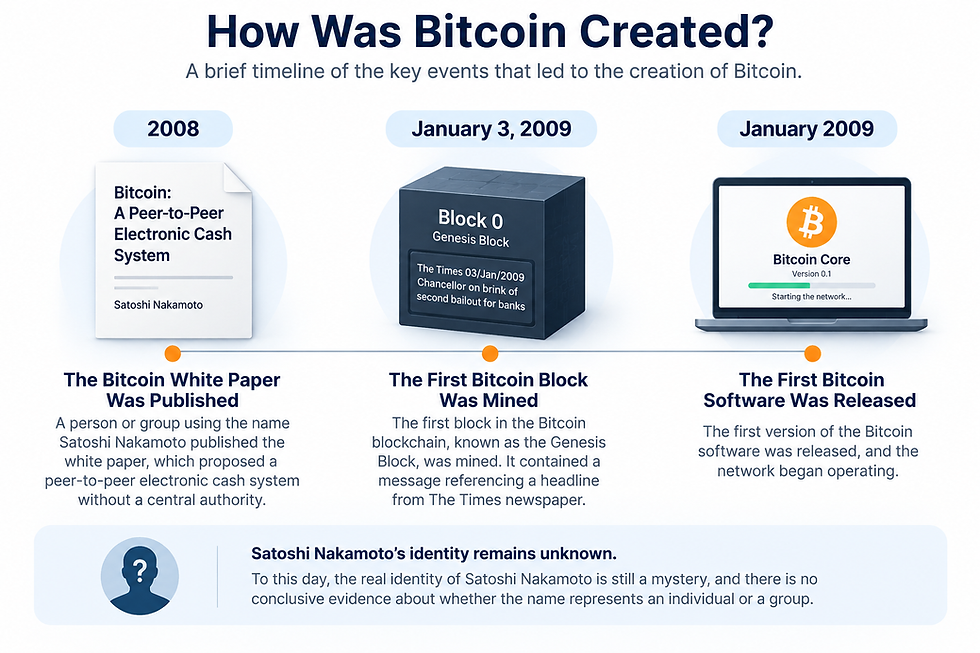
Bitcoin's history began in 2008, when a person or group using the name Satoshi Nakamoto published the Bitcoin white paper, Bitcoin: A Peer-to-Peer Electronic Cash System.
Key milestones include:
2008 → The Bitcoin white paper was published.
January 3, 2009 → The first Bitcoin block, known as the Genesis Block, was mined.
January 2009 → The first version of the Bitcoin software was released and the network began operating.
Bitcoin introduced a peer-to-peer system for transferring digital value without requiring a central financial institution to maintain the transaction ledger.
The real identity of Satoshi Nakamoto remains unknown.
🌐 Who’s the Controlling Party Behind Bitcoin?
Bitcoin is not controlled by a single person, company, bank, or government. Instead, it operates through a decentralized network of participants around the world.
Bitcoin's rules are enforced by software running across the network. Nodes independently verify transactions and blocks according to those rules, while miners help confirm transactions and add new blocks to the blockchain.
Developers can propose changes to Bitcoin's software, but they cannot force participants to adopt them. Major changes generally require broad support from the Bitcoin community and network participants.
This decentralized structure is one of Bitcoin's defining characteristics: no single central authority has complete control over the network.
Understanding Bitcoin and How It Works
🔗 Understanding Bitcoin
Bitcoin operates using a technology called blockchain—a public, distributed ledger that records Bitcoin transactions.
Transactions are grouped into blocks, which are connected in chronological order to form the Bitcoin blockchain. Copies of this ledger are maintained by computers called nodes across the network.
When a Bitcoin transaction is made, network participants verify that it follows Bitcoin's rules. Miners use computing power to compete to add valid blocks of transactions to the blockchain through Bitcoin's proof-of-work system.
Once transactions receive confirmations, altering them becomes increasingly difficult. This helps Bitcoin operate without relying on a central bank or payment processor to maintain its ledger.
Bitcoin Transaction → Verification → Block → Blockchain → Confirmations
🔑 Tokens and Keys
Bitcoin wallets use public and private keys to help users receive and control their BTC.
A private key is secret information that allows Bitcoin to be spent. It should never be shared with anyone, because anyone who gains access to the necessary private keys may be able to control the associated Bitcoin.
Bitcoin wallets also generate information used to receive payments, including Bitcoin addresses, which can be shared with others when receiving BTC.
In simple terms:
Bitcoin Address → Receive BTCPrivate Key → Authorize Spending
Keeping private keys and wallet recovery information secure is essential when using a self-custody Bitcoin wallet.
⚙️ How Bitcoin Works
Bitcoin works through a peer-to-peer network that allows users to transfer BTC without requiring a bank or central payment processor to record the transaction.
When someone sends Bitcoin, the transaction is broadcast to the network. Bitcoin nodes check whether it follows the network's rules, including whether the sender has the authority to spend those funds.
Valid transactions can then be included by miners in new blocks through Bitcoin's proof-of-work mining process. Once a block is added to the blockchain, the transaction begins receiving confirmations.
The more confirmations a transaction receives, the more difficult it becomes to alter or reverse.
Send BTC → Network Verification → Mining → Block Added → Confirmations
⚖️ Advantages and Disadvantages of Bitcoin
Like any payment technology or digital asset, Bitcoin has both advantages and disadvantages. Its decentralized design can offer greater control over funds and enable peer-to-peer transfers, but it also comes with risks such as price volatility, transaction irreversibility, security responsibilities, and changing regulations.
Understanding both sides is important before buying, holding, or using BTC.
Below, we'll look at the main advantages and disadvantages of Bitcoin in more detail.
✅ Advantages of Bitcoin
Bitcoin offers several features that distinguish it from traditional payment systems and financial assets. These include peer-to-peer transfers, global network access, user control over funds, transparent transaction records, and a fixed maximum supply.
However, some benefits depend on factors such as network conditions, wallet choice, local regulations, and how Bitcoin is being used.
🔐 Privacy and Pseudonymous Transactions
Bitcoin does not require personal information to be written directly into every blockchain transaction. Instead, transactions are associated with Bitcoin addresses.
However, Bitcoin is not anonymous. Its blockchain is public, and transaction activity can potentially be traced or linked to individuals through exchanges, wallet activity, or other identifying information.
Users should therefore think of Bitcoin as pseudonymous rather than completely anonymous.
🌍 Global Peer-to-Peer Transfers
Bitcoin allows users to send and receive BTC directly over its peer-to-peer network, without requiring a bank to process the transfer.
Because the Bitcoin network operates globally, transactions can be sent across borders wherever users have access to compatible Bitcoin services or wallets.
However, access to exchanges, wallets, and other crypto services may depend on local laws, regulations, and service availability.
💰 Lower-Cost Transfers in Some Cases
Bitcoin transactions can sometimes offer a cost-effective way to transfer value, particularly for certain cross-border payments.
However, Bitcoin transactions are not free. Users may pay a network fee, and the amount can vary depending on network demand, transaction size, and how quickly confirmation is desired.
Exchanges, wallets, and other services may also charge their own fees in addition to the Bitcoin network fee.
🌐 Accessibility
Bitcoin can be accessed and transferred digitally using a compatible wallet and an internet-connected device.
Because the Bitcoin network operates globally, users can send, receive, and store BTC without relying on a traditional bank account to interact directly with the network.
However, access to cryptocurrency exchanges and other services may require identity verification and may be restricted depending on local laws, regulations, and service availability.
✅ Disadvantages of Bitcoin
📉 Bitcoin Price Volatility
Bitcoin's price can be highly volatile, meaning its value may rise or fall significantly over relatively short periods.
Bitcoin's market price is influenced by factors such as supply and demand, investor sentiment, economic conditions, regulatory developments, and activity across cryptocurrency markets.
This volatility can create additional risk for people who hold BTC or plan to use it for payments, since the value of their Bitcoin may change between the time it is acquired and the time it is spent.
For this reason, Bitcoin should not be treated as a guaranteed store of value or a risk-free investment.
🔑 Risk of Losing Private Keys
When using a self-custody Bitcoin wallet, users are responsible for protecting the credentials that provide access to their BTC.
If a private key or recovery phrase is permanently lost and no backup is available, the associated Bitcoin may become inaccessible permanently.
If this sensitive information is stolen or exposed, an attacker may be able to transfer the Bitcoin to another wallet, and blockchain transactions generally cannot be reversed.
Using secure backups and protecting private keys and recovery phrases are therefore important parts of Bitcoin self-custody.
🛒 Limited Direct Merchant Acceptance
Although Bitcoin is widely known, direct Bitcoin payments are still not accepted by every retailer or service provider.
This means BTC cannot always be used at checkout in the same way as traditional payment methods such as credit cards or local currencies.
However, Bitcoin holders may have alternative ways to use their BTC for purchases. For example, supported cryptocurrencies can be used to purchase digital gift cards for various brands through services such as Jour Cards.
Availability still depends on the merchant, country or region, gift card terms, and supported payment options.
⚖️ Bitcoin Regulations and Legal Considerations
Bitcoin laws and regulations vary by country and jurisdiction. Some countries permit Bitcoin ownership and trading, while others restrict or regulate certain cryptocurrency-related activities.
Depending on the location and service being used, cryptocurrency users may be subject to identity verification, tax reporting, anti-money-laundering requirements, or other regulations.
Bitcoin transactions are also recorded on a public blockchain, so Bitcoin should not be considered completely anonymous or untraceable.
Because cryptocurrency regulations can change, users should check the applicable laws and requirements in their jurisdiction before buying, selling, or using Bitcoin.
🛠️ Ongoing Development and Network Changes
Bitcoin is an open-source network that continues to evolve through software development, research, and proposals from contributors around the world.
Developers can propose improvements to Bitcoin, but they cannot simply impose changes on the entire network. Participants—including node operators, miners, wallet providers, and other users—choose which software and rules they support.
Updates can improve areas such as security, efficiency, privacy, and scalability, but changes may also require extensive testing and broad community support.
Users and businesses should therefore keep their Bitcoin software and wallet practices up to date while understanding that the network can continue to develop over time.
💻 Digital-Only Nature
Bitcoin is a digital asset, so it does not exist as physical notes or coins that can be carried and exchanged like cash.
Using BTC generally requires access to a compatible wallet or cryptocurrency service, which may be less convenient for people who prefer traditional payment methods or have limited access to digital technology.
Bitcoin can be spent directly where supported, but not every merchant accepts BTC as a payment method. In other cases, users may use cryptocurrency payment services or purchase digital products such as gift cards with supported cryptocurrencies.
This makes Bitcoin useful for certain digital payments, but it is not yet a universal replacement for traditional payment methods.
💰 How Can You Get Bitcoin?
There are several ways to obtain Bitcoin (BTC). The most common method is buying Bitcoin through a cryptocurrency exchange or another supported trading service. Bitcoin can also be received as payment, transferred from another wallet, or earned through mining.
The available methods depend on your country, local regulations, payment method, and the cryptocurrency services available in your region.
Before buying Bitcoin, check the platform's fees, security practices, identity-verification requirements, withdrawal options, and supported blockchain network.
💳 How to Buy Bitcoin
One of the most common ways to obtain Bitcoin is to buy BTC through a cryptocurrency exchange or supported trading platform.
Depending on the service and your location, Bitcoin may be purchased using payment methods such as a bank transfer, debit card, or other supported options.
Before choosing a platform, consider its fees, security, reputation, withdrawal options, identity-verification requirements, and availability in your country.
After purchasing BTC, you may be able to keep it with the service or withdraw it to a compatible Bitcoin wallet, depending on the platform.
🔄 Peer-to-Peer and Decentralized Ways to Buy Bitcoin
Bitcoin can also be acquired through peer-to-peer (P2P) marketplaces and certain decentralized trading services.
P2P platforms connect buyers and sellers, allowing them to trade directly using supported payment methods. Depending on the platform, features such as escrow may be used to help facilitate the transaction.
Decentralized trading protocols work differently and may allow users to trade digital assets without relying on a traditional centralized exchange to custody funds.
These methods can involve additional complexity and risks, so users should carefully check fees, security, liquidity, payment terms, and platform requirements before making a transaction.
🏦 Buying Bitcoin From Centralized Exchanges
Centralized cryptocurrency exchanges (CEXs) are another common way to buy Bitcoin. These platforms are operated by companies that facilitate cryptocurrency trading and typically provide user accounts for buying, selling, and storing digital assets.
Depending on the exchange and your location, you may be able to purchase BTC using a bank transfer, debit card, or other supported payment methods.
Centralized exchanges may require identity verification (KYC) and can charge trading, deposit, or withdrawal fees. Available features, security protections, and withdrawal policies also vary between platforms.
Before choosing an exchange, users should review its reputation, fees, security measures, supported countries, and Bitcoin withdrawal options.
⛏️ Bitcoin Mining
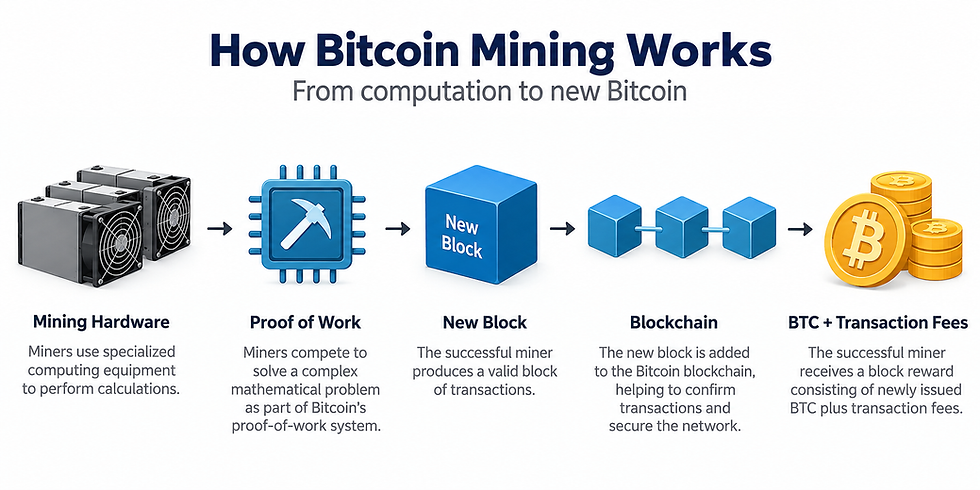
Bitcoin mining is the process that helps secure the Bitcoin network, confirm transactions, and add new blocks to the blockchain.
Miners use specialized computing equipment to perform calculations as part of Bitcoin's proof-of-work system. Miners compete to produce a valid block, and the successful miner can receive a block reward consisting of newly issued BTC plus transaction fees.
Bitcoin mining has become highly competitive and typically requires specialized hardware, significant electricity, and technical infrastructure. For this reason, mining Bitcoin directly may not be practical or profitable for many individuals.
Mining profitability can also change depending on factors such as Bitcoin's price, electricity costs, mining difficulty, hardware efficiency, and network conditions.
👛 What Is a Bitcoin Wallet?
A Bitcoin wallet is a tool that helps users manage the cryptographic keys needed to access and spend their BTC.
Contrary to the name, a Bitcoin wallet does not physically “store” Bitcoin. BTC remains recorded on the Bitcoin blockchain, while the wallet manages the keys that allow the user to control and authorize transactions.
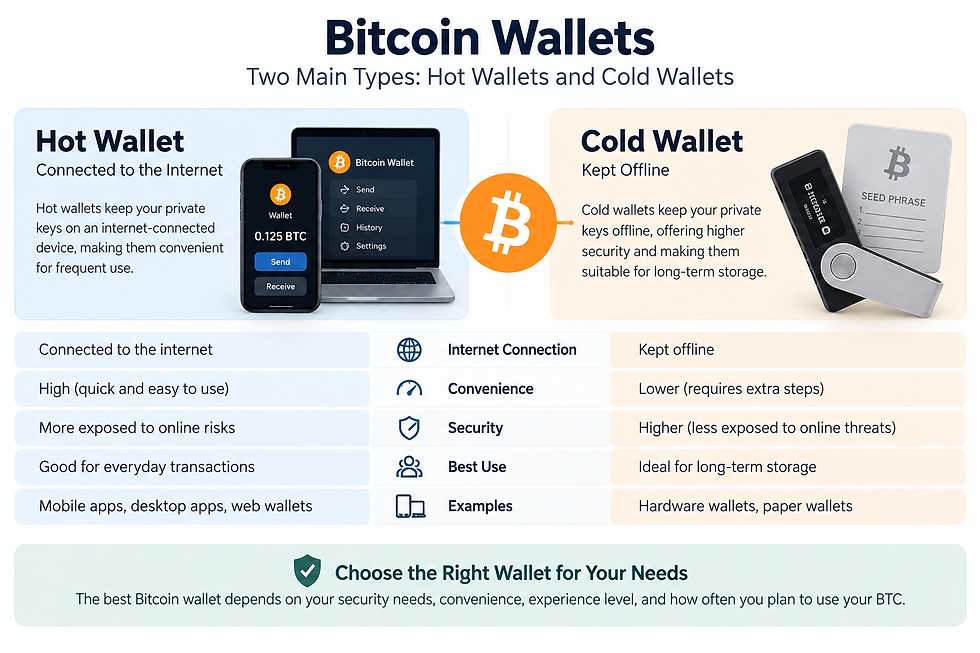
Bitcoin wallets can generally be divided into hot wallets and cold wallets, depending on whether the wallet's private keys are kept on an internet-connected device.
Choosing the right wallet depends on factors such as security, convenience, experience level, and how frequently you plan to use your Bitcoin.
🖥️ Desktop Bitcoin Wallets
Desktop wallets are Bitcoin wallet applications installed on a computer. They allow users to manage their Bitcoin keys and send or receive BTC directly from their desktop or laptop.
Depending on the wallet, users may control their own private keys, giving them greater control over their Bitcoin. However, the security of a desktop wallet also depends heavily on the security of the computer on which it is installed.
Users should protect their device from malware, unauthorized access, and data loss, and securely back up any required recovery information.
🌐 Web Bitcoin Wallets
Web wallets allow users to access and manage Bitcoin through a web browser or online cryptocurrency service.
They can be convenient because users may access their accounts without installing dedicated desktop software. However, the way private keys are managed varies between services.
With a custodial wallet, a third-party provider controls the private keys on the user's behalf. This means users must also consider the provider's security practices, account protections, and withdrawal policies.
Users should enable available security features such as two-factor authentication (2FA) and use strong, unique passwords when using online wallet services.
📱 Mobile Bitcoin Wallets
Mobile Bitcoin wallets are applications designed for smartphones and tablets, making it convenient to send, receive, and manage BTC while on the go.
Many mobile wallets support features such as QR-code scanning, which can simplify entering Bitcoin addresses when making or receiving payments.
Depending on the wallet, users may control their own private keys or rely on a custodial provider. Security therefore depends on both the wallet design and how well the mobile device is protected.
Users should protect their phones with strong authentication and securely back up any required recovery phrase or wallet information.
🔐 Hardware Bitcoin Wallets
Hardware wallets are physical devices designed to keep cryptocurrency private keys isolated from internet-connected devices during normal storage.
They are commonly used for cold storage because they can reduce exposure to online threats such as malware and remote attacks.
However, hardware wallets still require careful handling. Users should protect their recovery phrase, purchase devices from reputable sources, follow the manufacturer's security instructions, and keep backups in a secure location.
If the recovery information is lost or compromised, access to the associated Bitcoin may also be at risk.
🛍️ What Can You Buy With Bitcoin?
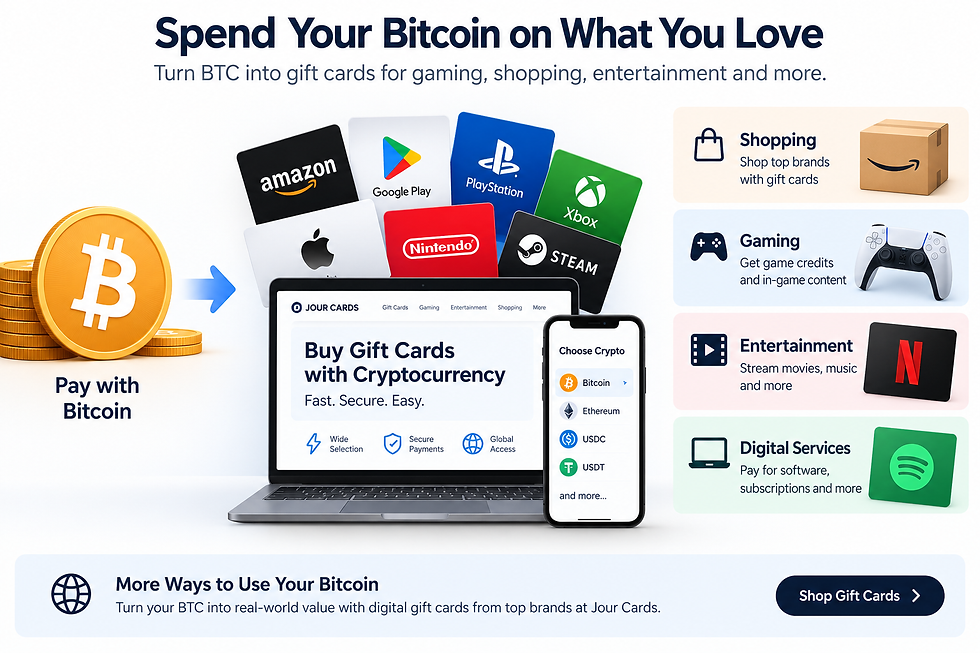
Bitcoin can be used to purchase a variety of digital products and services, although direct BTC acceptance varies between merchants, countries, and payment providers.
Depending on the retailer or service, Bitcoin may be used for products such as digital gift cards, gaming credits, subscriptions, online services, and other digital purchases.
Even when a particular brand does not accept Bitcoin directly, another option may be to purchase a compatible gift card with cryptocurrency and then redeem that gift card with the relevant brand.
This can give Bitcoin holders more ways to use their BTC for everyday digital purchases.
🎁 Buy Digital Gift Cards With Bitcoin at Jour Cards
Jour Cards makes it possible to use supported cryptocurrencies, including Bitcoin, to purchase digital gift cards for shopping, gaming, entertainment, and other online services.
Browse the available gift cards, choose the product and value you want, then select an available cryptocurrency payment option at checkout. After payment confirmation and applicable processing, the digital gift card is delivered electronically.
Gift card availability, denominations, currencies, and redemption requirements can vary by brand and region, so always check the product details before purchasing.
When paying with cryptocurrency, also make sure you send the correct asset using the exact blockchain network shown at checkout.
🔐 Buy Virtual Payment Cards With Bitcoin
Depending on current availability, Jour Cards may also offer virtual payment cards and prepaid card products that can be purchased using supported cryptocurrencies.
These products can provide another way to use cryptocurrency for online purchases where the specific card is accepted.
Before purchasing, carefully check the card's supported countries, currency, denomination, activation requirements, fees, expiration terms, and usage restrictions. Availability and redemption conditions vary by product and region.
Always review the individual product details before completing a cryptocurrency payment.
📱 Buy Mobile Top-Ups With Bitcoin
Jour Cards may also offer mobile top-ups that can be purchased using supported cryptocurrencies, providing another practical way to use Bitcoin and other digital assets.
Available mobile operators, countries, denominations, and payment options can vary. Before purchasing, select the correct country, mobile operator, and phone number and review the product details carefully.
After payment confirmation and applicable processing, the top-up is applied according to the terms of the selected product and mobile operator.
Always check the cryptocurrency and blockchain network shown at checkout before sending payment.
🌐 Buy Online Services With Bitcoin
Bitcoin can also be used to pay for certain online services and digital subscriptions where cryptocurrency payments are supported.
Depending on the provider, this may include services such as VPNs, web hosting, software, privacy tools, and other digital products.
Cryptocurrency payment availability can change over time and may vary by country, so always check the provider's current checkout options before sending BTC.
If a service does not accept Bitcoin directly, a compatible digital gift card may provide an alternative way to make the purchase.
🍔 Bitcoin for Food and Everyday Purchases
Bitcoin may also be used for food and everyday purchases, although direct cryptocurrency acceptance varies significantly between merchants and locations.
In some cases, a retailer may accept cryptocurrency directly or through a payment processor. Another option is to purchase a compatible digital gift card with Bitcoin and redeem it according to the brand's terms.
Always check the gift card's region, currency, denomination, and redemption requirements before purchasing.
🛍️ Other Things You Can Buy With Bitcoin
The ways Bitcoin can be spent continue to vary as merchants and payment services change their cryptocurrency support.
Depending on current availability, BTC may be used directly or indirectly for:
🎮 Gaming and game credits
🛒 Online shopping
🎬 Entertainment and subscriptions
📱 Mobile services and top-ups
💻 Software and digital services
🎁 Digital gift cards
For merchants that do not accept BTC directly, purchasing a compatible digital gift card with cryptocurrency can provide another way to use Bitcoin for eligible products and services.
⚖️ Should You Buy Bitcoin?
Whether you should buy Bitcoin depends on your financial situation, goals, risk tolerance, and understanding of cryptocurrency.
Bitcoin has become a widely recognized digital asset, but its price can be highly volatile. Its value can rise or fall significantly, and there is no guarantee that buying or holding BTC will result in a profit.
Before buying Bitcoin, consider factors such as price volatility, wallet security, transaction fees, local regulations, taxes, and the risk of losing access to your funds.
Bitcoin can also be useful beyond investing. Some people use BTC for peer-to-peer transfers and digital purchases, including buying supported gift cards and other digital products.
Ultimately, learning how Bitcoin works and understanding its risks is more important than relying on price predictions or investment hype.
❓ Bitcoin FAQs
❓What is Bitcoin in simple terms?
✅Bitcoin is a decentralized digital asset and cryptocurrency that allows users to transfer value through a peer-to-peer network. Transactions are recorded on a public blockchain rather than being maintained by a central bank.
❓How does Bitcoin work?
✅Bitcoin transactions are broadcast to a decentralized network, checked against the network's rules, and can be included in blocks by miners using proof of work. Confirmed blocks become part of the Bitcoin blockchain.
❓Is Bitcoin anonymous?
✅Bitcoin is not completely anonymous. Transactions are recorded on a public blockchain. Bitcoin addresses do not automatically reveal a person's identity, but transaction activity can potentially be analyzed and linked to individuals or organizations.
❓What is a Bitcoin wallet?
✅A Bitcoin wallet manages the cryptographic keys used to access and spend BTC. Wallets can include mobile, desktop, web, and hardware solutions.
❓Can you buy gift cards with Bitcoin?
✅Yes. Services such as Jour Cards allow customers to purchase supported digital gift cards using Bitcoin and other available cryptocurrencies. Product availability, regions, denominations, and payment options can vary.
Can Bitcoin transactions be reversed?
✅Confirmed Bitcoin transactions generally cannot be reversed through the Bitcoin network. Any refund usually requires cooperation from the recipient or merchant.
🚀 Final Conclusion
Bitcoin introduced a decentralized way to transfer digital value without requiring a central bank or payment processor to maintain the transaction ledger.
Understanding what Bitcoin is, how the blockchain works, how wallets protect access to BTC, and the advantages and risks involved can help users make more informed decisions about cryptocurrency.
Bitcoin can also have practical uses beyond holding or trading it. Where supported, BTC can be used for digital purchases, including gift cards, gaming products, entertainment, and other online services.
If you want to use cryptocurrency for digital purchases, explore the available products at Jour Cards and always check the product region, redemption requirements, supported cryptocurrency, and blockchain network before completing your payment.
Learn how to pay with cryptocurrency


nh88 mình lướt thử cho biết vì thấy bạn bè nhắc, kiểu vào xem giao diện có dễ dùng không thôi. Ấn tượng đầu là trang chia nội dung theo từng khối nhìn khá thoáng, đọc lướt không bị ngợp chữ. Mình có ghé qua phần hỏi đáp thấy họ nói rõ mấy chuyện cơ bản như đăng ký thì bấm “Đăng ký” ở trang chủ rồi điền thông tin, xong kích hoạt xong muốn lấy code tân thủ thì phải nhắn CSKH online 24 7. Mình không có thời gian test sâu nhưng cách họ trình bày kiểu câu hỏi–trả lời gọn gàng nên tìm thông tin nhanh. Nhìn chung thao tác bấm qua lại cũng ổn, và mấy…
https://o8bo.jp.net/ hôm trước mình cũng tò mò vào nghía thử vì thấy bạn bè nhắc hoài. Mình không kiểu tìm hiểu kỹ đâu, chỉ lướt xem giao diện với cách họ trình bày thông tin thôi. Cảm giác đầu tiên là trang khá dễ nhìn, nền sáng và chữ không bị rối mắt, kéo xuống vẫn biết mình đang đọc phần nào. Có đoạn nói về bảo mật với mã hóa SSL nên mình thấy yên tâm hơn chút, ít nhất là họ có nhắc rõ chứ không giấu. Mình xem trên điện thoại cũng ổn, bấm menu qua lại nhanh, không bị lạc hay phải quay vòng nhiều lần. Nói chung cái mình thích nhất là các khối nội…
https://sc88a.it.com/ hôm bữa thấy bạn bè nhắc nhiều nên mình mở thử cho biết, kiểu xem giao diện ra sao thôi. Vào cái là thấy trang phản hồi khá nhanh, không phải chờ lâu hay load lắt nhắt. Mình thích cái cách họ làm bố cục nhìn gọn, chia nội dung theo từng khối nên lướt một lúc là nắm được ý chính, không bị rối mắt. Thử trên điện thoại cũng ổn, cuộn mượt, chữ dễ đọc, bấm mấy mục không bị lệch hay phải phóng to thu nhỏ liên tục. Nói chung cảm giác họ tối ưu theo hướng dễ dùng, nhìn phát hiểu ngay. Menu với các khối nội dung đặt rõ ràng nên tìm thông tin…
nhà cái SX88 mình vừa ghé thử vì thấy mọi người nhắc hoài, kiểu vào xem cho biết thôi chứ không định ngồi lâu. Ấn tượng đầu là trang tải khá nhanh, chuyển qua lại mấy mục mà không bị đứng hay chờ vòng vòng. Giao diện nhìn cũng dễ chịu, bố cục gọn gàng nên lướt một lúc không bị rối mắt. Mình để ý họ sắp xếp nội dung theo từng khối khá rõ, nên muốn tìm thông tin cơ bản là thấy ngay, không phải kéo mệt. Cảm giác họ làm theo hướng ưu tiên trải nghiệm người dùng hơn là nhồi chữ. Nói chung nhìn ổn áp, nhất là phần menu và các khung nội dung…
https://manclub.gb.net/ mình lướt thử hôm qua vì thấy bạn bè nhắc hoài, kiểu vào xem cho biết thôi. Ấn tượng đầu là giao diện nhìn khá “sạch”, bố cục chia khu rõ nên không phải mò mẫm nhiều. Màu phối hiện đại nhưng dịu mắt, ngồi đọc vài phút không bị mỏi. Mình dùng điện thoại, bấm qua lại thấy ổn, chuyển trang nhanh và không bị lệch chữ hay dính nút như mấy site hay gặp. Có thấy họ để phần hỗ trợ 24/7 khá nổi, nên nếu có thắc mắc chắc cũng dễ hỏi. Nói chung mình chỉ xem sơ sơ, nhưng mấy block nội dung và tiêu đề sắp xếp gọn, nhìn phát là hiểu ngay trên…